Anyone who has studied English has a favourite struggle: the seemingly insane number of tenses. You’re supposed to use all of them, but it’s not always clear which one to choose.
A tense contains information about two things:
1) when an action happens and
2) what kind of action it is.
The first one can be indicated by three basic times: present, past, and future. We talk about actions and states that either happened in the past, are happening in the present, or will happen in the future — and it’s hard to invent anything beyond that.
There are also hypothetical actions — things that would have happened, but the conditions weren’t met. That’s handled by the subjunctive / conditional area.
English also has future-in-the-past, which is used when, in the past, someone said something about the future. Because in English it matters where an action is located relative to the moment of speaking (now), this can create confusion.
Maria said she would go on holiday.
Where is that holiday relative to “now”? Has she already gone away? Is she there right now? Or has she not left yet? To avoid this confusion, we put Maria’s holiday into the future-in-the-past: it is “future” only relative to the moment when Maria talked about it, and it has no direct link to the present moment. Phew!
So we’ll look at 3 + 1 “times”: the present, the past, the future, and (as a bonus) future-in-the-past.
The second one is aspect. Recall the aspects in your language if there are any. I’ll make an example in Russian I also teach. Russian verbs in terms of aspect can be either perfective or imperfective. Why exactly these? Because in Russian it matters whether an action is completed or not. If we list all Russian tenses, we get:
- Present: делаю (I do / I am doing)
- Past imperfective: делал (I was doing / I used to do)
- Past perfective: сделал (I did / I have done)
- Future imperfective: буду делать (I will be doing / I will do)
- Future perfective: сделаю (I will do / I will have done)
Perfective verbs are not used in the present, so you end up with five forms.
Now let’s look at what English needs to show through aspect. English aspect can be simple, continuous, perfect (perfect simple) — does that remind you of the aspects in your language? — and perfect continuous.
If you look closely, these are not four unrelated aspects. They’re basically two “splits” into pairs:
- two simple and two continuous forms,
- two perfect and two non-perfect forms.
If we add future-in-the-past, we have four “times”. Four times multiplied by four aspects makes sixteen tenses.
time \ aspect | simple | continuous | perfect simple | perfect continuous |
present | I play. | I am playing. | I have played. | I have been playing. |
past | I played. | I was playing. | I had played. | I had been playing. |
future | I will play. | I will be playing. | I will have played. | I will have been playing. |
future-in-the-past | I would play. | I would be playing. | I would have played. | I would have been playing. |
How to digest this 16-cell “monster”? Let’s simplify it. Compare the fourth row (future-in-the-past) with the third row (future). What’s the same, and what’s different? Exactly: the only difference is will → would. So if you master the “future” row well, you can build future-in-the-past automatically by replacing will with would. That’s right. So we can learn less: focus on the first three rows.
When learning languages, it helps a lot to be observant — to spot similarities, differences, and patterns. Let’s look at what all simple forms (the first column) have in common. The main (lexical) verb is in the base form (infinitive without to) everywhere, except in affirmative Past Simple. That’s an exception — because in negatives and questions you still use the base form.
What do all continuous forms (the second column) have in common? The main verb is always in the -ing form. The auxiliary is also the same: it’s the verb to be in the relevant tense (present, past, future, or future-in-the-past). In other words, only the form of be changes; the main verb stays in the same -ing form. If you look at perfect continuous, the main verb is also always -ing. And there are two auxiliaries there, one of them being be. Conclusion: all continuous forms contain be, and the main verb is in the -ing form.
Now a task for you: what auxiliary do all perfect forms (the third and fourth columns) share, and what form comes immediately after it (of the main verb, or the second auxiliary)?
The lower and farther right a form sits in the table, the longer and “more complex” it looks. But in practice, the shortest forms (top-left) often take the longest to learn. They’re used more frequently, so over time they develop more irregularities and exceptions. The easiest forms to handle are those with -ing (in this table, those are participle forms). There are no exceptions in how the -ing form is built: it follows one consistent rule.
To use tenses effectively, you need to know two things for each one: a) how it is built; b) when it is used.
The first point is a pattern based on the word order of the sentence core (the core consists of the subject — the doer — and the predicate — what they do). English word order is fixed. That means each sentence type has a strict pattern that does not change. There are three sentence types: affirmative, negative, and question.
Let’s look at the pattern for Present Continuous.
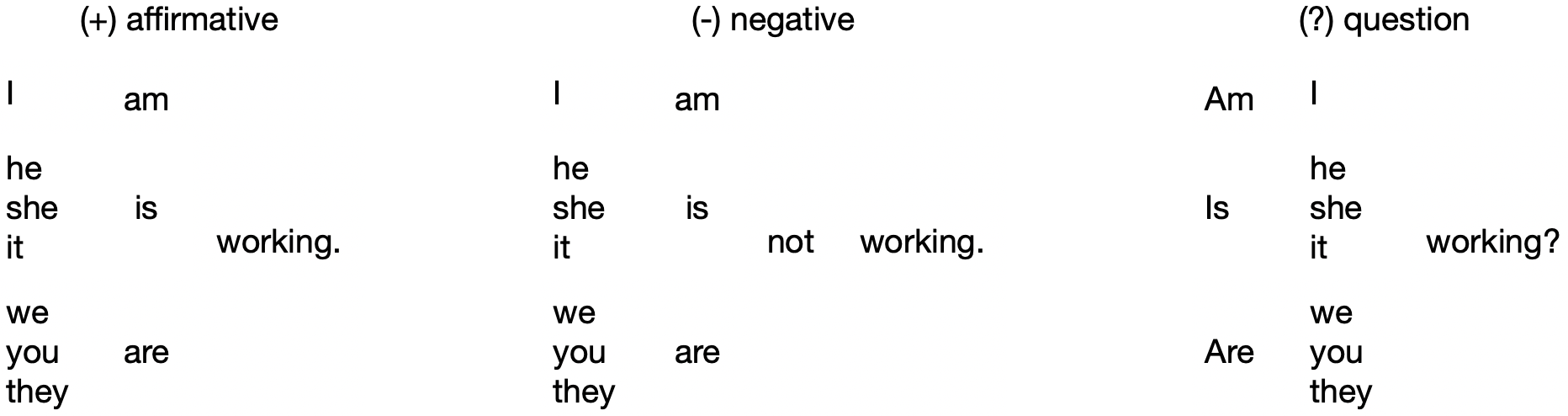
You can make a similar table for every tense–aspect form, and grammar books contain all of them. If you build such tables for at least a few forms, you quickly see that the pattern itself stays the same from form to form. For example, in a question, position zero is the question word (if there is one), position one is the auxiliary verb, then comes the subject, then the main verb in the required form. After that come the other parts of the sentence, also in a specific order.
Only the auxiliaries change (for example, in all continuous forms the key auxiliary is be), and the form of the main verb changes (for example, in perfect forms you use the third form / past participle). But the word order stays the same. That’s why it’s “fixed”: learn it once for affirmative, negative, and questions, and you don’t need to learn it sixteen times. As the saying goes: a miser pays twice, and a lazy person learns the same word order sixteen times.
The second thing you need is when to use each form. Let’s start with a simple visual idea of aspect.
Imagine time as a line going from left to right: past on the left, future on the right, and the present in the middle. That’s how we usually picture time, right?

Each specific moment is a point on the line. For example, “yesterday at 10 a.m.” is one exact moment — one point. If an action happened exactly at that moment (a single event), we use the simple aspect. For example:
The doorbell rang at 10 o’clock yesterday.
A long action is not a point but a segment, and we express it with the continuous aspect.

She was drawing a picture from 10 to 12 yesterday.
Perfect simple forms are about a result by a certain point in time. Duration and repetition aren’t important — only the result at that point. In Present Perfect, the result is achieved by the moment of speaking.

I have written four compositions so far.
If you want to focus on duration, use perfect continuous. The “arrow” still reaches a certain point:
I have been writing this composition for two hours.
So, time shows which time reference point the action is connected to: present, past, or future. Aspect shows what kind of “shape” the action has: we can picture simple as a point (single action) or many points (regular action), continuous as a segment, and perfect as an arrow that reaches a specific point.
The usage rule for each tense is a list of typical situations (speech contexts) that English expresses using that form. For example, Present Continuous is used for:
- an action happening at the moment of speaking I’m studying an English rule right now.
- a planned future action I’m going to the cinema tonight.
- changes happening during the current period The population of the world is increasing.
- with always, constantly, all the time, too often to show a repeated action that annoys the speaker He’s constantly making noise!
Each form has its own set of situations. The closer a form is to the top-left corner of the table, the more usage cases it has. The closer to the bottom-right, the closer that number becomes to one.
In textbook exercises, context is given on purpose (for example, it clearly points to the needed form through time expressions like since I was a child, all evening yesterday), and you choose the form that matches. In real life, we usually go the other way. First, a thought appears in your head, you already know what time frame you mean, and then — when you put the thought into words — you might not use any time expression at all. The time frame will be clear from the verb form itself. Verb forms carry extra meaning and emotional colouring too. It would be beautiful to learn to express subtle shades of meaning through grammar — it brings us closer to the way native speakers think.
What we have in the end
- There are only three basic times: present, past, and future. Tense shows the point in time the action is connected to.
- English has four aspects: simple, continuous, perfect simple, perfect continuous. Aspect shows the character of the action.
- English has fixed word order. Learn it once for affirmatives, negatives, and questions, and apply it across all tenses.
- Each tense has a clear set of usage cases. All you need to know is the building pattern and these cases.
- Almost every sentence you produce is one of these cases, and you need to know them all to choose the correct form.